12 Mistakes to Avoid When Buying Property in Spain

The most expensive mistakes when buying property in Spain rarely show up while you're still choosing an apartment. They surface only after the deposit is paid or the deed is signed at the notary — a point where fixing anything is difficult or impossible, and the cost of the mistake is measured in real money.
- 1. Property in Spain: What Do You Actually Need It For?
- 2. Can You Judge the Costa Blanca Property Market by Listings Alone?
- 3. How Do You Choose a Real Estate Agent in Spain?
- 4. Costa Blanca. Is It Worth Working with Several Agencies at Once?
- 5. What Should You Know Before Signing an Arras Deposit in Spain?
- 6. What Restrictions Apply on the Costa Blanca?
- 7. Why Do You Need a Full Legal Check Before Signing?
- 8. Property on the Costa Blanca: What Will It Really Cost?
- 9. Why Does Liquidity Matter When Buying?
- 10. How Much Can You Actually Earn Renting Out Property on the Costa Blanca?
- 11. Buying Property in Spain: How Do You Estimate the Timeline Correctly?
- 12. What Should Be Included in the Deal, Not Sold as "After-Sales Service"?
- Related Reading
- Frequently Asked Questions
Espavista has worked with property in Spain since 2008. Below are the mistakes we see most often, year after year.
1. Property in Spain: What Do You Actually Need It For?
The most common mistake is starting the search before deciding why you actually need property in Spain: to live in, to rent out, or to resell in a few years. Without a clear goal, the choice comes down to emotion — a nice renovation, an attractive price, a sea view. The result is often a rushed decision (buyers frequently have just a week for viewings) and a property that doesn't quite fit the original plan.

2. Can You Judge the Costa Blanca Property Market by Listings Alone?
Demand for housing on the Costa Blanca outstrips supply. Buyers often find that a large share of online listings are already sold, reserved, not legally ready for a sale, or carry hidden restrictions — and some listings exist purely as a marketing tool. The real picture of the market comes not from listings but from actual property availability and closed-deal statistics: an up-to-date Costa Blanca property catalogue is refreshed faster than listing aggregators.
3. How Do You Choose a Real Estate Agent in Spain?
Working with an agent in Spain rarely ends once the deed is signed at the notary. After the purchase come utility transfers, questions about renting the property out, and other administrative tasks. Without Spanish and a grasp of how the system works, handling this alone is hard. That's why an agent should be chosen not as a one-off intermediary but as a partner for years ahead.

It's also worth confirming you're working with a professional by checking the licence, which confirms professional qualification and mandatory liability insurance — unregistered intermediaries have neither. You can verify an agent's registration through the official Generalitat Valenciana website.
In standard practice in Spain, the agent's commission is paid by the seller, and only after the deal closes at the notary.
4. Costa Blanca. Is It Worth Working with Several Agencies at Once?
Working with several agencies in parallel can look like a way to see more properties. In practice, it usually backfires: the focus shifts from the safety of the deal to competition between agencies for the client. Working with one agency on the Costa Blanca doesn't limit market access, since Spanish agencies share a common property database.
5. What Should You Know Before Signing an Arras Deposit in Spain?
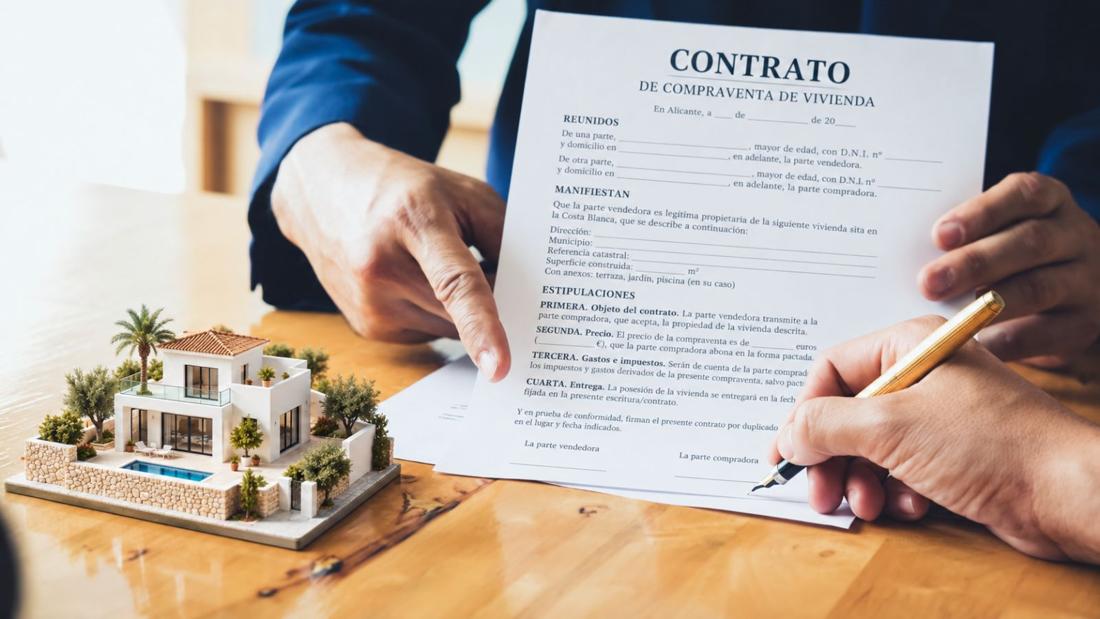
In Spain, the arras deposit isn't a formality. It's a real commitment that fixes the terms of the deal, the timeline, and the financial liability of both buyer and seller. Signing before fully checking the property can mean losing the deposit — typically around 10% of the price. That's why an arras contract should only be signed once every check is complete.
6. What Restrictions Apply on the Costa Blanca?
A property's appearance doesn't reveal every legal nuance. One often underestimated risk comes from the coastal protection law (Ley de Protección de Costas), which restricts properties in the coastal zone from being extended or renovated. Such properties may also face demolition in the future.
7. Why Do You Need a Full Legal Check Before Signing?
A superficial check of the property — or pushing it off until the notary appointment — is one of the costliest mistakes when buying property in Spain. Once the deal closes, the buyer takes on debts to the homeowners' association (comunidad de propietarios), tax liabilities, unpaid utility bills, and any liens (embargos) that weren't uncovered beforehand. A full legal check should happen before signing the arras deposit, not after.
8. Property on the Costa Blanca: What Will It Really Cost?
On the Costa Blanca, budget roughly an extra 10–12% on top of the purchase price for related costs. That figure often surprises buyers who focus only on the listing price. It includes: for resale property — the property transfer tax (9% of the price); for a new build — 10% VAT plus a 1.4% stamp duty. Either way, you'll also pay notary fees (usually €600–1,000) and Land Registry fees (€400–800).

9. Why Does Liquidity Matter When Buying?
Without a liquidity check, a property can turn from an asset into a liability: a place you love isn't always easy to resell if this wasn't considered when choosing it. How much demand a property will have among future buyers, not just the current one, is worth assessing before the deal — not when it's time to sell.
10. How Much Can You Actually Earn Renting Out Property on the Costa Blanca?
Renting out property on the Costa Blanca is a workable strategy, but expectations should be checked against real figures, not the ones advertised online. Long-term rentals in Spain provide predictable income. Short-term rental success depends on experienced management. Either way, factor in vacancies between tenants and furniture wear and tear, which optimistic estimates often skip. Before pencilling in expected profit, check it against statistics and local management practice for the specific area — that's what makes the number realistic rather than a sales pitch.

11. Buying Property in Spain: How Do You Estimate the Timeline Correctly?
A cash purchase in Spain can take 6–10 weeks from the start of the search to signing at the notary. With a mortgage, it takes longer. Getting an NIE and opening a bank account are steps that can run in parallel if organised correctly — which is exactly how experienced agencies keep to realistic timelines.
12. What Should Be Included in the Deal, Not Sold as "After-Sales Service"?
Some agencies in Spain break out key parts of the transaction — coordinating the deal, working with the notary, getting an NIE, opening a bank account, transferring utility contracts — into separate paid services branded as "after-sales service". In reality, all of this is part of standard transaction support, not an add-on. Before agreeing to work with any agency in Spain, it's worth clarifying which services are included and which will cost extra.
Related Reading
Frequently Asked Questions
Can you avoid mistakes when buying property in Spain without an agency?
Technically, yes — but most mistakes involve information that isn't visible during a viewing: legal status, Ley de Costas restrictions, the real cost of ownership. Without access to this data, buyers either spend significant time checking everything themselves or make the decision blind.
Where should I start if I'm only considering buying property in Spain?
Start by defining your purpose — living in it, holidays, renting it out, or resale — and by estimating a realistic budget that covers not just the price but all related costs. These two decisions set the direction for everything else in the search.
Are getting an NIE and opening a bank account included in transaction support in Spain?
Worth confirming before you start working with anyone. Practices differ: some agencies include this in standard support (NIE, opening an account, coordinating with the notary), others charge for each separately. At Espavista, these steps are part of the standard property purchase support service, with no separate invoice for each stage.
Do property-buying mistakes differ across regions of Spain?
The general logic of the mistakes is the same nationwide, but some details are regional: Ley de Costas restrictions apply to coastal properties, not those inland, and tax and utility rates vary by autonomous community and municipality.
What should I do if I've already signed the deposit and found a problem with the property?
It depends on the specific arras contract's terms and the nature of the problem — there's no universal answer. In this situation, consult a property specialist in Spain as quickly as possible.